Heraklion & Crete

September in one of the Mediterranean’s most extraordinary places

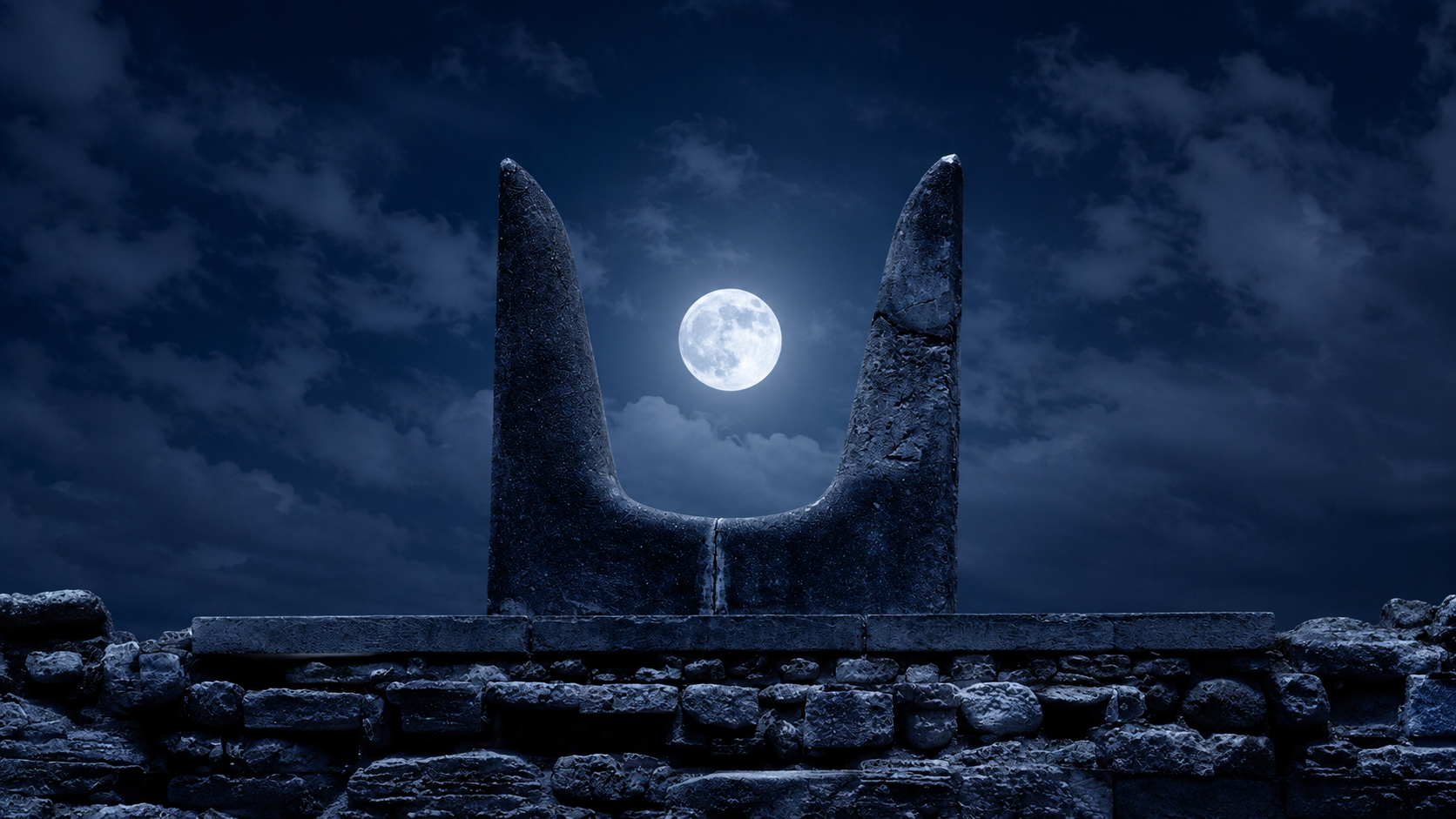
Full moon rising between the Minoan Horns of Consecration, Crete

September is widely considered the finest month to visit Crete. The sea is warm, ideal for swimming. The summer crowds have eased and the island is more relaxed, more itself. All facilities, restaurants, and attractions remain fully open. The weather is warm and settled, perfect for exploring both coast and interior.

Plan extra days: before the seminar, after it, or both. Crete is one of the great islands of the Mediterranean, and late September is its finest moment. There is far more to discover than Heraklion alone. To the west lies the old Venetian harbour town of Chania, one of the most beautiful towns in Greece. The Samaria Gorge, one of Europe’s great walks, descends through the White Mountains to the Libyan Sea. The Lasithi Plateau, the villages of the Apokoronas, the quiet coves of the south coast: each warrants a day of its own. September gives you warm water, open roads, and an island that has found its natural pace again. Make the most of it.

Crete is more than just a destination; it is a timeless land where ancient civilisations, breathtaking landscapes, and vibrant energy converge. Known as the cradle of the Minoan civilisation, Crete is deeply connected to ancient Egypt through trade, culture, and shared spiritual practices; both civilisations decisively influencing the history of the Mediterranean, Europe, and the world.

Heraklion, the capital of Crete, offers a rich blend of ancient history and modern charm. It is from here that the great Minoan palace at Knossos was administered, and it is here that the finest Minoan objects in existence are held, in one of Europe’s greatest museums.

Sights & Culture

Click any entry to expand

Museum of Ancient Greek Technology (Kotsanas Museum) A remarkable museum of working reconstructions of ancient Greek inventions Map 4.9 ★

A remarkable museum of working reconstructions of ancient Greek inventions: early automata, proto-computing mechanisms, astronomical instruments, hydraulics, and more. Staff demonstrate the devices live. Compact, under an hour, but with interactive logic puzzles upstairs that invite more time. Housed in a Venetian-era building on Epimenidou Street, the same street as the Lato Boutique Hotel. The highest-rated museum in the city.

Historical Museum of Crete Covers Byzantine, Venetian, and Ottoman Crete through to the Second World War Map 4.6 ★

Covers Byzantine, Venetian, and Ottoman Crete through to the Second World War. Contains two original El Greco paintings, the only ones on permanent display in Greece, and the recreated study of Nikos Kazantzakis, Heraklion’s most celebrated son. Often overlooked by visitors focused on the Minoan period; rarely crowded and all the better for it.

Venetian Fortress of Koules The sea fortress at the entrance to the Venetian harbour, completed 1540 Map 4.6 ★

The sea fortress at the entrance to the Venetian harbour, completed 1540. Withstood repeated Ottoman attacks for over a century. Panoramic views of the sea and city from the battlements. A museum inside documents the history of Heraklion under Venetian rule.

Venetian Harbour The old Venetian port, beautiful at any hour, especially at sunset Map 4.6 ★

The old Venetian port, beautiful at any hour, especially at sunset and after dark when the lights reflect off the water. The lighthouse pier extends 3 km out to sea for those wanting a longer walk. Cafe Marina sits directly on the harbourfront.

  • AccessAlways open, free
  • Rating4.6 ★
Morosini Fountain (Lions Square) The beating heart of Heraklion. This 17th-century Venetian fountain Map 4.5 ★

The beating heart of Heraklion. This 17th-century Venetian fountain, adorned with lions, tritons, dolphins, and nymphs, sits in a lively square ringed by cafés and shops. The ideal starting point for a morning in the city; Kir Kor bougatsa is right on the square.

  • AccessAlways open, free
  • Rating4.5 ★
Cathedral of Saint Titus A layered palimpsest of Venetian, Ottoman, and Greek history Map 4.7 ★

A layered palimpsest of Venetian, Ottoman, and Greek history within a single building: constructed as a Catholic basilica, converted to a mosque under Ottoman rule in 1669, and reclaimed as an Orthodox church in 1925. Houses the head relic of Saint Titus, Crete’s patron saint, which was held in Venice for nearly three centuries before being returned in 1966.

  • HoursDaily 7am–7:30pm
  • AddressAgiou Titou 16, 71202 Heraklion
  • Phone+30 281 022 4839
  • Rating4.7 ★
Herakleion Central Market, 1866 Street Heraklion’s traditional covered market street. Cretan cheeses, thyme honey Map 4.4 ★

Heraklion’s traditional covered market street. Cretan cheeses, thyme honey, olive oil, herbs, leather goods, and souvenirs. Best visited in the morning. The street runs straight down to the seafront. Open Sunday until 2pm only.

  • HoursMon–Sat 9am–9pm, Sun 9am–2pm
  • Rating4.4 ★
Bembo Fountain & Kornarou Square Heraklion’s oldest fountain, built in 1552, the first running water Map 4.4 ★

Heraklion’s oldest fountain, built in 1552, the first time running water reached the city. Sits at the southern end of the market street. The adjacent Ottoman pump house has been sympathetically converted into a charming outdoor café; good coffee under the trees.

  • AccessAlways open, free
  • Rating4.4 ★
Venetian Walls of Heraklion Among the most formidable Renaissance fortifications ever constructed Map 4.5 ★

Among the most formidable Renaissance fortifications ever constructed. The walls withstood a 21-year Ottoman siege, the longest such siege in recorded history, before the city finally fell in 1669 through famine rather than breach. A walk along the ramparts offers sweeping views of the city and surrounding landscape. Free and always accessible.

  • AccessAlways open, free
  • Rating4.5 ★
Eleftherias Square (Liberty Square) Heraklion’s grand civic square, adjacent to the Archaeological Museum Map

Heraklion’s grand civic square, immediately adjacent to the Archaeological Museum. Pleasant for an evening stroll and coffee, with views across the old walls toward the sea and the port.

  • AccessAlways open, free

The Three Practitioner Challenges

These challenges are offered to participants as a fun way of putting measuring and perceptual skills to work in the field before the seminar begins. They are not tests, and there are no answers to report: the value is in the measurements.

Challenge 1

The Archaeological Museum: Hidden Pendulums & BG3 Artefacts

The Minoan jewellery and artefact collections at the Heraklion Archaeological Museum contain multiple pieces that are, in the BioGeometry sense, pendulums, objects whose form, proportion, and hanging geometry produce measurable energy responses. They are on display in plain sight among thousands of other objects, with no special marking.

The challenge: Move through the jewellery sections and attempt to identify, by direct perception alone, which pieces are BG3 emitters before reading the labels or studying the object descriptions. Beyond the jewellery, many other artefacts throughout the museum also emit BG3: vessels, figurines, seals, ritual objects. See how many you can locate across the full collection.

This is also an opportunity to observe how the Minoans, who shared deep cultural and trade connections with ancient Egypt over more than a millennium, embedded energetic function into everyday wearable and ceremonial forms, not as a separate spiritual practice, but as integral to the objects themselves.

Practical note: Allow at least 2 hours. The jewellery collections are on the ground floor. The museum is large and easy to rush; resist the temptation. Note that the museum opens at 1pm on Wednesdays.

Challenge 2

Knossos: The BG3 Lines of the Palace

The Palace of Knossos was not built on its site arbitrarily. Major BG3 lines traverse the site, lines that predate the palace by an unknown period and almost certainly determined where it was placed and how it was oriented. The structures themselves follow these lines: the spatial sequence of courts, corridors, and chambers can be read as a map of the energy grid beneath.

The challenge: Before reading any site information or following a guided narrative, enter the site and attempt to locate and trace the major BG3 lines using your perception and tools. Then observe how the architectural layout follows their path: which spaces sit on the lines, which at their intersections, and which are deliberately offset. Consider the relationship between the orientation of the palace and the energy topography of the land.

The palace was built without defensive walls. The Minoans felt no need for them. Understanding the energy of the place is part of understanding why.

Practical note: Allow at least 3 hours; more if possible. Arrive early to avoid crowds. Buy tickets online in advance. Take Bus 2 (€1.50 one-way) or a taxi (~€10–12) from the city centre.

Challenge 3

The City Itself: BG3 Lines at the Squares and Monuments

Heraklion’s old city is not a random accumulation of buildings. The squares surrounding the two cathedrals, Saint Titus and the Cathedral of Saint Minas, and the areas around several of the major monuments (the Morosini Fountain, the Bembo Fountain, the Venetian Harbour entrance) all sit at or near significant earth energy lines. Some of these are major BG3 lines; others are crossing points.

The challenge: As you walk the city, between meals, before a museum visit, in the evening, bring your awareness (and if you choose, your tools) to these spaces. Notice where the quality of the space shifts. Notice which spots draw you to stand still, and which seem to deflect passage. Observe whether the placement of the monuments and the geometry of the squares reflects an underlying energetic logic, as it very often does in old Mediterranean cities whose form evolved organically over centuries rather than being planned on a grid.

Food & Drink

Click any entry to expand

Kir Kor: Traditional Bougatsa A Heraklion institution, open since the mid-20th century, on Lions Square Map 4.6 ★

Do not leave Heraklion without eating bougatsa here.

A Heraklion institution, open since the mid-20th century, on Lions Square. Bougatsa is warm, flaky filo pastry filled with semolina cream, dusted with cinnamon and icing sugar; the definitive Cretan breakfast. Always order the traditional cream version. Best eaten early, straight from the oven, at the outdoor tables watching the square come to life.

  • HoursDaily 6am–10pm
  • AddressPlateia El. Venizelou 31, 71202 Heraklion
  • Phone+30 281 024 2705
  • Rating4.6 ★
Cafe Marina, Old Harbour Relaxed café directly on the Venetian harbourfront, looking straight out Map 4.3 ★

Relaxed café directly on the Venetian harbourfront, looking straight out at the Koules Fortress. The ideal spot for a slow Greek coffee or an afternoon drink watching the boats. Good food also available.

  • HoursDaily 9am–1am
  • AddressLeoforos Nearchou, Venetian Harbour, 71202 Heraklion
  • Phone+30 281 022 1345
  • Rating4.3 ★
Peskesi Exceptional farm-to-table Cretan restaurant in a beautiful garden courtyard Map 4.8 ★

Exceptional farm-to-table Cretan restaurant in a beautiful garden courtyard. Ingredients sourced from the restaurant’s own farm: legumes, wild herbs, cheeses, and meats that are genuinely local and seasonal. One of the most celebrated dining experiences on the island. Book well in advance; it fills up consistently.

Avli A family-run meze taverna considered by many locals to be the finest Map 4.9 ★

A family-run meze taverna considered by many locals to be the finest food in the city. The menu is in Greek only; the staff explain each dish warmly and with evident pride. Order snails, staka, liver, lamb chops, mussels in ouzo. Cretan cooking at its most authentic and unhurried. Book ahead. Closed Monday and Sunday.

  • HoursTue–Sat 1:30pm–midnight
  • AddressSmirnis 31, 71201 Heraklion
  • Phone+30 281 301 7784
  • Rating4.9 ★
Lola Creative Cretan cooking in a warm, intimate space just off Lions Square Map 4.8 ★

Creative Cretan cooking in a warm, intimate space just off Lions Square. Outstanding aubergine starter; the cannelloni is particularly well reviewed. Ends the meal with raki and loukoumades in true Cretan style. Closed Tuesday and Wednesday.

  • HoursMon, Thu–Sun 12:30pm–1am
  • AddressKidonias 21, 71202 Heraklion
  • Phone+30 281 022 4827
  • Rating4.8 ★
Petousis Taverna A Heraklion institution. Classic Greek taverna cooking: stuffed vine leaves Map 4.6 ★

A Heraklion institution. Classic Greek taverna cooking: stuffed vine leaves, lamb, pork steak, seasonal vegetables. Large, bustling, and reliably good. Book ahead for evenings.

Planning Your Time

Time Requirements

  • Archaeological Museum: minimum 2 hours; allow a full morning for Challenge 1
  • Knossos Palace: minimum 3 hours; allow a full morning or afternoon for Challenge 2
  • Museum of Ancient Greek Technology: 1–1.5 hours
  • Historical Museum of Crete: 1–1.5 hours
  • Full walking tour of the city centre (harbour, walls, squares, monuments): 2–3 hours

Museum Closures to Note

  • Archaeological Museum: opens at 1pm on Wednesdays
  • Kotsanas Museum: open daily, no day off
  • Historical Museum of Crete: open daily
  • Koules Fortress: closed Tuesdays